

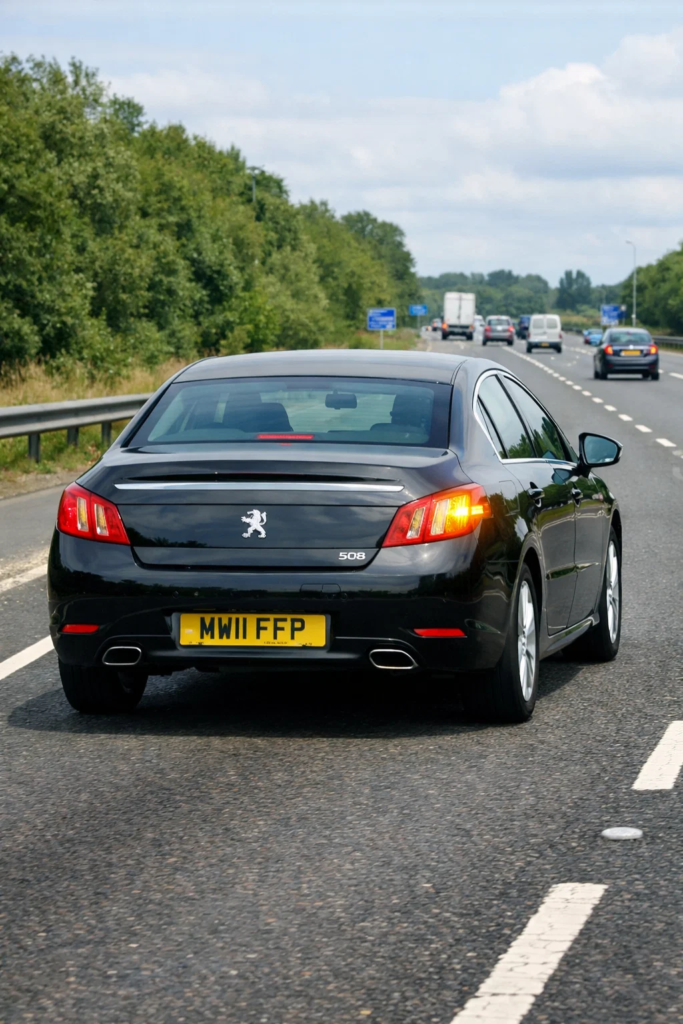
🚘 SIGNALLING ON UK ROADS — THE GUIDES
1️⃣ The Core Principle
Always “Mirror – Signal – Manoeuvre” (MSM).
Before any turn, lane change, or move that affects other road users:
Check mirrors → Give signal → Then act.
🪞 1. MIRROR
Check:
- Interior mirror first (for what’s directly behind you).
- Then door mirror (for what’s to the side or in your blind spot).
Do this in good time — before braking or steering.
🚨 2. SIGNAL
Use your indicators (turn signals or hand signals) when:
- You are about to change direction (left/right turn or roundabout).
- Pull up or move off.
- Change lanes.
- Overtake another vehicle.
- Enter or leave a roundabout or junction.
📏 3. DISTANCE / TIMING BEFORE JUNCTIONS
There’s no single fixed distance (because roads and speeds vary),
but DVSA guidelines suggest “in good time, not too early or too late.”
Here’s a rule of thumb:
| Road Type / Speed | Approx. Timing to Signal Before Junction | Example |
| 20–30 mph (urban area) | About 3–5 seconds before the turn | Roughly 30–45 metres before the junction |
| 40–50 mph (rural or main road)** | At least 5–7 seconds before | Roughly 60–75 metres before the junction |
| 60–70 mph (dual carriageway or motorway)** | About 8–10 seconds before | Roughly 100 metres (or more, depending on conditions) |
✅ Golden Rule:
Signal early enough for others to see and react,
but not so early that other road users think you’re turning before another junction.
⚙️ Practical DVSA Example (Urban Setting)
Approaching a left turn on a 30 mph road:
- Mirror – check interior and left mirror.
- Signal – indicate about 3 car lengths (≈ 30 m) before the junction.
- Manoeuvre – reduce speed, position to the left, check for pedestrians, then turn.
⚠️ Common Faults During Tests
- Signalling too late – the examiner marks “late or no signal”.
- Signalling too early – confuses drivers at earlier junctions.
- Not cancelling the signal after a turn.
- Signalling unnecessarily – e.g., on a quiet road with no one to benefit.
📘 References
- Highway Code: Rules 103–106
- DVSA Driving the Essential Skills
- DVSA Official Guide to Learning to Drive