

Speed and Stopping Distance is one of the most crucial Highway Code topics for UK learner drivers and instructors.
Below is a complete One Time Pass Driving School guide to Speed and Stopping Distance, including formulas, tables, graph, and safety principles.
🚗 SPEED & STOPPING DISTANCE — UK HIGHWAY CODE GUIDE
(One Time Pass Driving School — Highway Code Learning Series)
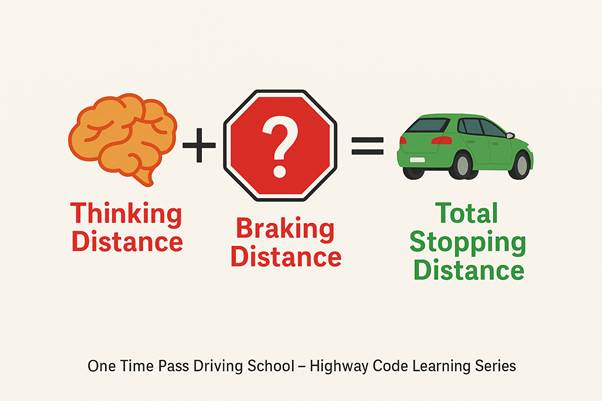
🧮 1️⃣ The Formula
Thinking Distance + Braking Distance = Total Stopping Distance
🧠 2️⃣ Thinking Distance
The distance your car travels from the moment you see a hazard to the moment you start to press the brake.
It depends on:
- Your reaction time (usually 1 second average).
- Your speed.
- Concentration level (tiredness, distractions, alcohol, drugs, mobile use).
🧭 Approximation formula:
🛑 3️⃣ Braking Distance
The distance your car travels after you press the brake until it fully stops.
It depends on:
- Tyre condition and tread depth.
- Road surface (wet, icy, gravelly).
- Brake condition.
- Weight/load in the vehicle.
🧭 Approximation formula:
📏 4️⃣ Full Stopping Distance Table (UK Highway Code)
| Speed (mph) | Thinking Distance (m) | Braking Distance (m) | Total Stopping Distance (m) | Equivalent Car Lengths |
| 20 | 6 | 6 | 12 | ~3 |
| 30 | 9 | 14 | 23 | ~6 |
| 40 | 12 | 24 | 36 | ~9 |
| 50 | 15 | 38 | 53 | ~13 |
| 60 | 18 | 55 | 73 | ~18 |
| 70 | 21 | 75 | 96 | ~24 |
⚠️ All based on dry road, good tyres, and an alert driver.
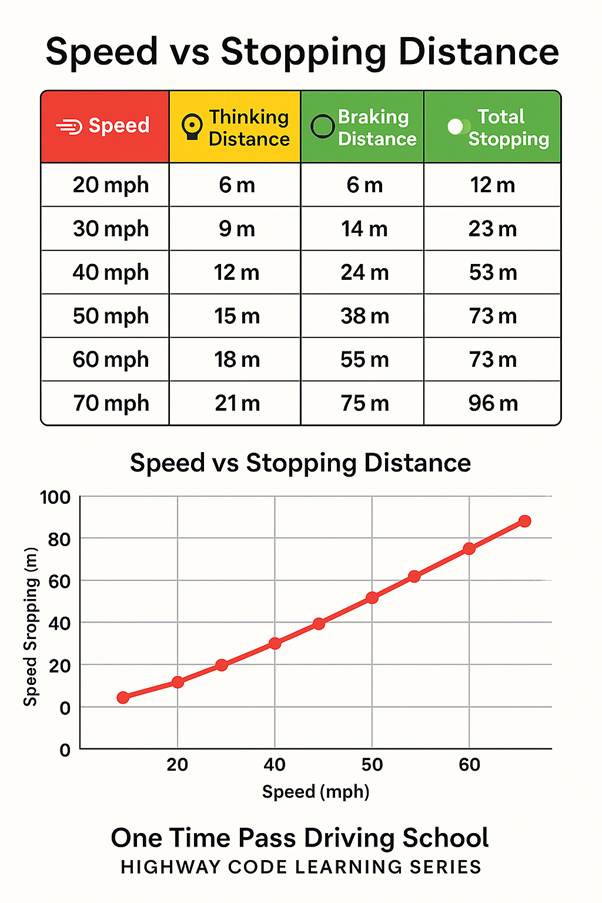
📊 5️⃣ Infographic Table
| 🏎️ Speed | ⏱️ Thinking Distance | 🛑 Braking Distance | 📏 Total Stopping | 🧭 Key Reminder |
| 20 mph | 6 m | 6 m | 12 m | Town traffic / schools |
| 30 mph | 9 m | 14 m | 23 m | Built-up areas |
| 40 mph | 12 m | 24 m | 36 m | Rural roads |
| 50 mph | 15 m | 38 m | 53 m | A-roads |
| 60 mph | 18 m | 55 m | 73 m | Single carriageways |
| 70 mph | 21 m | 75 m | 96 m | Dual carriageways & motorways |
📈 6️⃣ Graph — Speed vs Stopping Distance
| Speed (mph) | Stopping Distance (m) |
| 20 | 12 |
| 30 | 23 |
| 40 | 36 |
| 50 | 53 |
| 60 | 73 |
| 70 | 96 |
⚙️ 7️⃣ What Affects Stopping Distance
| Factor | Effect |
| Wet / icy road | Increases braking distance × 2–10 |
| Worn tyres or brakes | Reduces grip → longer stop |
| Heavy load | Increases braking distance |
| Road gradient | Uphill shortens, downhill lengthens |
| Poor visibility | Delays reaction time |
🧠 8️⃣ What Affects Thinking & Braking Distance
| Thinking Distance (mental) | Braking Distance (mechanical) |
| Fatigue | Tyre pressure / condition |
| Alcohol / drugs | Road surface (wet, icy) |
| Distraction (phone, talking) | Brake pad wear |
| Inexperience / overconfidence | Vehicle weight or trailer load |
| Poor eyesight | Speed itself (energy = ½ mv²) |
🕹️ 9️⃣ Applying the Routine Before a Junction
Just like the Mirror–Signal–Manoeuvre routine, you should start preparing for your stop or turn in good time.
| Speed | Begin slowing / mirror routine before junction |
| 20–30 mph | ~30–45 m (about 3–5 seconds) |
| 40–50 mph | ~60–75 m (about 6–7 seconds) |
| 60–70 mph | ~100 m+ (8–10 seconds) |
✅ Golden Rule:
“Check mirrors before changing speed — brake progressively and early, never sharply.”
🧍♂️ 10️⃣ How to Stay Safe on UK Roads
- Keep a safe following distance — use the “two-second rule” (double in wet weather and ten times the normal weather condition on Icy Roads).
- Plan ahead — look well beyond the car in front.
- Avoid distractions — no mobile use or fiddling with screens.
- Stay visible — use dipped headlights when needed.
- Adapt your speed — match road, traffic, and weather conditions.
- Check mirrors before every change of speed, direction, or signal.
- Drive smoothly — avoid harsh acceleration or braking.
- Respect speed limits — they are the maximum, not a target.
Pingback: SIGNALLING ON UK ROADS — THE GUIDES - One Time Pass Driving School SIGNALLING ON UK ROADS: Essentials tips for a safe driving and passing your driving test.